
PSV test questions Malaysia — free practice test and licence guide
PSV Test Questions Malaysia is a free practice site for the JPJ PSV licence. So you want to drive a taxi or join an e-hailing platform in Malaysia — and you have heard you need something called a PSV licence first. You are in the right place. Practise here with the questions, signs tests and guides that make up PSV Test Questions Malaysia — starting with the test questions (road law, road signs, passenger safety, defensive driving), then follow the plain-English guide through the real process: the JPJL8A medical, the 6-hour PSV course, and registering at JPJ.
Quick check — try one now
From the practice bank. The full test is on the practice test page.
Before applying for a PSV licence, how long must you have held a full Competent Driving Licence (CDL)?

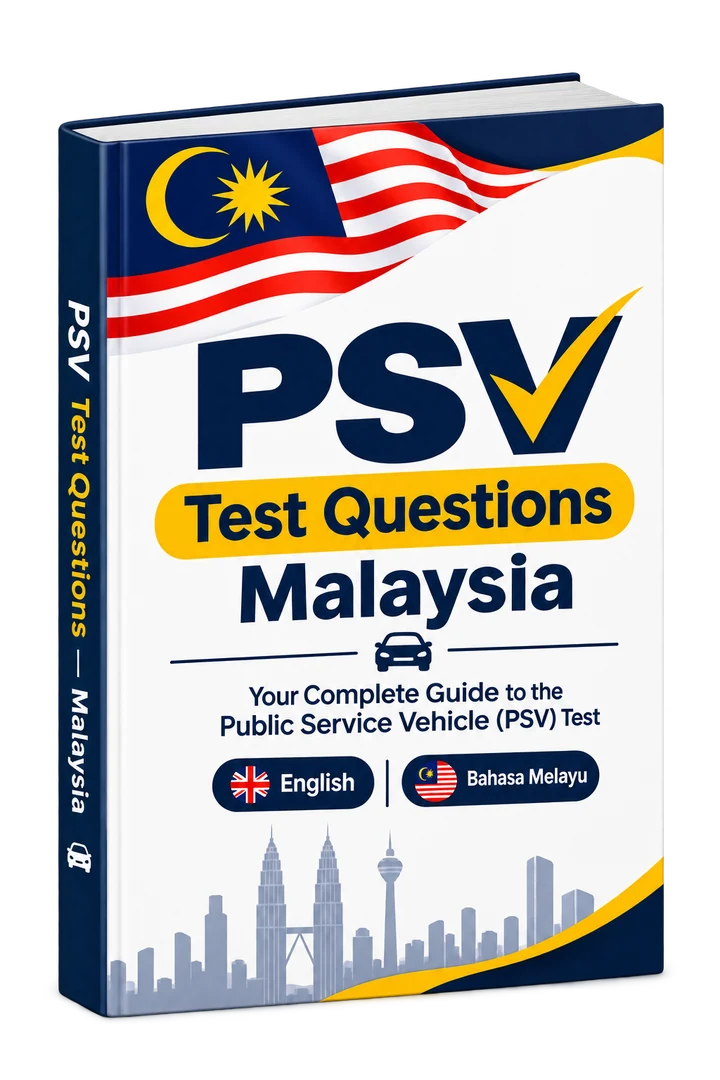
Paid Ebook — One-Time Purchase
Practise in deep with the complete ebook
The free side of PSV Test Questions Malaysia gives you the essentials. The ebook goes all the way: real, quality study content built from the actual PSV course syllabus — everything in one book that you download once and keep forever. No subscription, no monthly fee: one payment, and it is yours for good.
- Complete and up to date — written for today’s course-based system, not the old written exam
- Every traffic sign — the complete Malaysian sign library, each sign pictured and explained in plain words
- The complete PSV process — eligibility, the JPJL8A medical, the 6-hour course hour by hour, JPJ registration, renewal and e-hailing activation
- Deep practice sets — extended questions for every topic, with answers explained the way the course teaches them
- Checklists that save trips — what to bring, course-day kit, JPJ-day documents and the renewal countdown
One-time purchase · Instant download · Read it on your phone or print it
How to get your PSV licence — the short version
Check you qualify
Malaysian citizen or permanent resident, aged 21 or above, holding a CDL class D/DA valid for more than one year, with no JPJ/PDRM blacklist and outstanding summonses cleared.
Do the JPJL8A medical check
Take the JPJL8A form to any registered clinic. The doctor checks your health and eyesight for vocational driving. It costs around RM50 and the report is valid for one year.
Attend the 6-hour PSV course
Book at any JPJ-registered driving institute (institut memandu). Fee: RM70–RM200, capped by the Ministry of Transport. You will receive the JPJL2C certificate when you complete it. Find one on the test centres page.
Register at JPJ
Take your MyKad, CDL, JPJL8A medical form, JPJL12 form, JPJL2C certificate and one colour photo (25mm × 32mm, white background) to a JPJ state or branch office in the same state where you trained. Note: JPJ counters inside UTCs do not handle PSV registration.
Renew every year
A PSV licence is valid for one year only. Renewal needs a fresh JPJL8A medical each time. Let it lapse for more than 3 years and you may have to start again.
PSV test questions Malaysia — practise by topic
Weak on signs? Rusty on road law? Work through one topic at a time in practice mode — every answer is explained as you go.
- Full PSV mock test40 random questions, timed, 80% pass level
- Road signs test12 Malaysian signs, drawn and explained
- PSV licence & lawEligibility, forms, fees, renewal, KEJARA
- Passenger safety & serviceSeatbelts, sick passengers, lost property, conduct
- Defensive drivingRain, blowouts, brake failure, following distance
- Question bankEvery question with answers — read and revise
PSV test questions Malaysia — driving for a living? Start here.

A PSV licence is not a formality. Passengers — including children, elderly people and tourists who do not know the roads — trust you with their safety on every trip. The course, the medical and the questions on this site all cover the same ground: Malaysian road law under the Road Transport Act 1987, the KEJARA demerit system, reading signs correctly at speed, looking after passengers, and staying calm when something goes wrong.
Whether you are joining Grab, Bolt, inDrive or Maxim, driving a taxi in Kuala Lumpur, or moving up to van or bus work, the route is the same: qualify, get medically checked, attend the course, register at JPJ, and keep the licence renewed. This site walks you through each part in plain English, with the official forms named and the real costs listed — no sign-up, no fees, nothing to download.
PSV licence classes, eligibility and renewal → · Find a PSV course near you →
What a PSV licence actually is — in detail

Let us clear up the most common confusion first. PSV stands for Public Service Vehicle — but the licence belongs to you, not the vehicle. It is a vocational licence added to your ordinary driving licence, and it changes what you are legally allowed to do with that licence: carry passengers who pay you. Without it, driving a taxi or accepting a paid e-hailing trip is an offence, your operator cannot activate you, and your insurance may not cover an accident that happens on a paid trip.
JPJ (Jabatan Pengangkutan Jalan, the Road Transport Department) issues PSV under the Road Transport Act 1987. APAD (the Land Public Transport Agency) regulates the e-hailing side — operators and vehicle permits. The two meet on your car: you hold the PSV, your car holds an EVP, and both must be valid every time you take a paying passenger.
| Job you want | Licence you need | Notes |
|---|---|---|
| E-hailing driver (Grab, Bolt, inDrive, Maxim, AirAsia Ride) | PSV D — E-hailing | Plus EVP for the car, e-hailing insurance and sticker |
| Taxi / kereta sewa driver | PSV D — Taxi / Kereta Sewa | Same course; operator or taxi company requirements may add steps |
| Airport transfer / chauffeur / tour car driver | PSV D | Employers usually ask for PSV before hiring |
| Van or mini-bus driver (school van, factory van, tour van) | PSV D — Van / Mini bus | Vehicle class on your CDL must match |
| Bus or coach driver | PSV E — Bus | Requires CDL class E; heavier medical and employer checks |
| Lorry / goods van driver | Not PSV — GDL | Goods work is a different vocational licence; see PSV vs GDL |
Inside the 6-hour PSV course — module by module

The course is a single day at a driving institute, and attendance for the full six hours is the legal requirement — arrive late or leave early and the institute may not issue your certificate. The syllabus is set nationally, so whichever institute you choose, the content is broadly the same:
| Module | What it covers | Why it matters to you |
|---|---|---|
| Vocational licence rules | What PSV allows and forbids, classes of licence, validity and renewal, your duties as a licence holder | Most licence cancellations start as “I didn’t know” — this module removes that excuse |
| Road law & the Road Transport Act 1987 | Speed limits, alcohol limit (0.05%), seatbelts, phone offences, right of way, overtaking rules | The law you are tested on here is the law JPJ and PDRM enforce on you daily |
| KEJARA demerit points | How points are added offence by offence, and the suspension thresholds | A private driver can survive points; a professional can lose his income — know the numbers |
| Road signs & markings | Regulatory, mandatory, warning and guide signs; yellow box junctions; lane markings | The fastest marks in any assessment — revise with our signs guide |
| Defensive & courteous driving | Following distance, anticipation, driving in heavy rain and floods, fatigue management | Your passengers judge you on smoothness and calm, not speed |
| Passenger handling & service | Safe pick-up and drop-off points, helping elderly and disabled passengers, children, complaints, lost property, refusing fares | Service conduct is where most e-hailing account warnings come from |
| Vehicle checks & emergencies | Daily walk-around checks, tyre and brake condition, breakdown and accident procedure, what to do when a passenger is ill | The day something goes wrong, this module is the difference between panic and procedure |
Going in prepared changes the day completely. Work through the question bank the night before — the same topics, in the same order.
Then and now: the old PSV exam vs today’s system
| Before (written exam system) | Today (course system) | |
|---|---|---|
| How you qualified | Attend training, then sit a JPJ written examination | Attend the full 6-hour PSV theory course at a registered institute |
| Questions | 60 objective questions | No separate JPJ written exam for most applicants; institutes may run an end-of-course assessment |
| Pass mark | 48 of 60 (80%) | Attendance plus any institute assessment |
| Medical | JPJL8A — required | JPJL8A — still required, before registration |
| Certificate | Result, then PSV card within about 5 working days | JPJL2C course certificate, then register at JPJ |
| Validity | 1 year | 1 year — unchanged |
Rules differ for some categories and can change — the Ministry of Transport and JPJ sites are the final word. Our mock test keeps the old 80% standard deliberately: if you can pass it, you understand the syllabus, whichever system assesses you.
A simple 7-day preparation plan
Day 1–2 — Licence and law
Read the licence guide and the licence & law questions — the core of PSV test questions Malaysia candidates prepare for. Book your medical and your course while the rules are fresh.
Day 3 — Road signs
Go through the signs guide, then take the signs test until 12/12 feels easy.
Day 4–5 — Safety topics
Passenger safety, defensive driving and vehicle checks in practice mode — read every explanation, especially rain driving and emergencies.
Day 6 — Full mock
Sit the 40-question mock in exam conditions. Your best score is saved on this device so you can watch it climb.
Day 7 — Course day
Documents in a folder, arrive early, phone on silent. You have already seen the material once — the course becomes revision, not new information.
PSV test questions Malaysia — how to use this site
Check yourself
Run the 60-second eligibility checker so you know exactly where you stand.
Learn the rules
Read the question bank topic by topic — answers explained, nothing hidden.
Test under pressure
Take the timed mock test and the signs test until you pass comfortably.
Do the real steps
Medical, course, JPJ — follow the step-by-step guide and find your centre.

Everything on this site is free, works on your phone, and needs no account. Your mock scores are saved only on your own device.
Free tools for PSV drivers
- Eligibility checkerFive questions, a straight answer, your personal next steps
- Cost calculatorSlide the course fee, add medical and photo, see your real total
- Renewal date calculatorEnter your expiry date — see days left and when your window opens
- JPJ office hoursState offices, UTC counters, Friday breaks and weekend states
- JPJL8A medical guideWhat the doctor checks, what to declare, what happens if referred
- PSV sample questionsWorked sample questions with explained answers
Words you will keep meeting — a plain glossary
PSV test questions Malaysia — common questions
Is there still a written PSV exam in Malaysia?
For most new taxi, kereta sewa and e-hailing applicants, the old written PSV examination has been abolished by the Ministry of Transport. Today you qualify by attending the full 6-hour PSV theory course at a JPJ-registered driving institute. Some institutes still run an end-of-course assessment, and rules can differ by category, so practising real PSV test questions is still the best way to walk in prepared — and to actually learn the road law you will be judged on as a professional driver.
How many questions are in the PSV practice test here?
Our full mock draws 40 questions at random from a bank of 50+ original practice questions covering PSV licence law, road signs, passenger safety, defensive driving, vehicle checks and Malaysian road law. The pass level is set at 80% — the same standard the old official exam used (48 out of 60).
How much does a PSV licence cost in Malaysia?
Budget roughly RM150–RM280 in total: the 6-hour course costs RM70–RM200 (the fee is capped at RM200), the JPJL8A medical check at a clinic is typically around RM50, and JPJ charges a small processing fee (about RM30). Prices vary by institute and clinic, so confirm before you book.
Who needs a PSV licence?
Anyone who carries paying passengers in Malaysia: taxi and kereta sewa drivers, e-hailing drivers (Grab, Bolt, inDrive, Maxim and others), van and mini-bus drivers, and bus drivers. Each vehicle class has its own PSV class — see the licence classes page.
Can I get a PSV licence on a P licence?
No. You need a full Competent Driving Licence (CDL), class D or DA, that has been valid for more than one year, and you must be at least 21 years old.